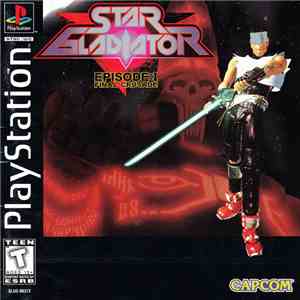
» » Isao Abe, Yuko Kadota - Star Gladiator

Isao Abe, Yuko Kadota - Star Gladiator FLAC download

  • Performer: Isao Abe
  • Title: Star Gladiator
  • Size FLAC ver: 1990 mb
  • Country: Japan
  • Released: 1996
  • Style: Soundtrack
  • Other formats: DXD WAV APE MIDI AU FLAC ASF
  • Genre: Stage and Screen
  • Rating: 4.4 of 5
Isao Abe, Yuko Kadota - Star Gladiator FLAC download

Tracklist

01 Untitled (Game Data [Unplayable]) 4:34
02 Untitled (Character Select) 2:20
03 Untitled (Stage 1) 2:42
04 Untitled (Stage 2) 3:00
05 Untitled (Stage 3) 3:07
06 Untitled (Stage 4) 2:56
07 Untitled (Stage 5) 2:15
08 Untitled (Stage 6) 3:12
09 Untitled (Stage 7) 2:47
10 Untitled (Stage 8) 2:08
11 Untitled (Stage 9) 2:04
12 Untitled (Stage 10) 2:11
13 Untitled (Special Stage) 2:08
14 Untitled (Continue) 0:19
15 Untitled (Good Ending Hayato) 1:11
16 Untitled (Good Ending June) 1:14
17 Untitled (Good Ending Saturn) 1:20
18 Untitled (Good Ending Gamof) 1:03
19 Untitled (Good Ending Gerelt) 1:11
20 Untitled (Good Ending Rimgal) 1:08
21 Untitled (Good Ending Zelkin) 1:13
22 Untitled (Good Ending Vector) 1:02
23 Untitled (Good Ending Gore) 0:58
24 Untitled (Good Ending Bilstein) 1:00
25 Untitled (Bad Ending) 0:45
26 Untitled (Staff Roll) 2:00
27 Untitled (Name Entry) 0:42
28 Untitled ([Dead Air]) 3:30

Credits

  • Composed By – Isao Abe (tracks: 03. 04, 06, 10, 12), Yuko Kadota* (tracks: 05, 07, 08, 09, 11, 13)

Notes

Redbook Audio from the PlayStation One game Star Gladiator Episode I: Final Crusade. The subtitle is dropped because it is not referred to on the spine of the game's insert or elsewhere for the most part.

Like most redbook audio there are no names attached to the files on the disc itself, the names above in parentheses come from the official soundtrack release (https://www.localhost/release/8646071). It should be noted that the music on official soundtrack is different than the music included on the PlayStation port game disc. The original arcade audio includes the same exact compositions, but is filtered through the sound capabilities of the ZN-1 arcade board. Capcom quote unquote "remastered" the audio for the home release so this version sounds a little more refined and takes advantage of the PlayStation's sound capabilities. (Tracks 03 and 08 see the most improvement from this upgrade).

Track #01 is unplayable because it's game data; track 28 is playable but is just 3:30 minutes of dead air.

Composition credits are taken from the liner notes of the arcade OST.

Barcode and Other Identifiers

  • Barcode: 0 13388 21018 3

Other versions

Category Artist Title (Format) Label Category Country Year
VICL-2174 Isao Abe, Yuko Kadota* Isao Abe, Yuko Kadota* - Star Gladiator ‎(CD) Victor VICL-2174 Japan 1996

Comments (1)

MeGa_NunC
Star Wars and Star Gladiator. Hi concept, sci-fi rigmarole. Beyond their setting and having the word “star” in their title there might not appear to be too much in common with these products. One spawned a massively successful media empire while the other led to a so-so sequel before it was barely heard from again. While some will say this is a classic case of apples and oranges, there was a point where the oranges almost became apples. Originally slated to be a game in the Star Wars franchise, instead of abandoning their first, in-house 3D fighter after the license was pulled, Capcom performed a soft reset instead. While using assets from the beloved Lucas Arts property was off the table, this didn’t mean the minds at Capcom couldn’t take influence from this resource. The result was Star Gladiator, what Star Wars might have encompassed had the property originated as a video game by Capcom.Such wild what if’s aside, its games like Star Gladiator that make me sad. While it can be said the game came out at the right time (coming out after the first two Battle Arena Toshinden games but before Namco’s Soul Blade) the game didn’t catch on. I’ve seen Capcom describe the game as a success in related promotional material, yet like most game publishers I think there was a bit of exaggeration in that statement. Still, as much as I love the roster of characters in Star Gladiator, I have to admit that as a bunch they’re so offbeat they probably weren’t attractive to everyone out there. While I wouldn’t want to alter the cast in anyway, the roster’s loss was the game’s loss because behind that bizarre line-up was a good-looking, solid three-dimensional fighter that made great use of its PlayStation-related ZN-1 arcade board. But there was one element of the ZN-1 hardware that lagged behind the rest: sound.To those familiar with Capcom’s home ports of their arcade classics in the mid nineteen-nineties, the idea that Star Gladiator’s audio was below par for what the PlayStation could offer is no surprise. Love it or hate it, the Q-Sound technology in Capcom’s arcade cabinets could be improved upon once a game was up for porting. To me, one of the most notable of cases of such an upgrade was Street Fighter Alpha 2, but then I doubt many people beyond those with nostalgia goggles saw the audio in the neutered SNES port to be an improvement. That said, whereas games in other genres needed to rely on sequenced music due to the size of their scores and the game itself, Star Gladiator’s existence as one-on-one fighter meant more resources were open to developers when the game was being ported. This was especially true due to the fact that the PlayStation made use of optical media. Instead of bringing the music from the arcade over to Sony’s console verbatim, Capcom instead re-recorded the entire soundtrack so the game could access the music off the disc on the fly.Of course, this means you can access the enhanced, PS1 Star Gladiator soundtrack just by putting the disc in an everyday CD player or a computer with a CD-ROM drive. While hardly the first game to do this (check out the first two Battle Arena Toshinden games for some more great tunes) what does this mean for the soundtrack containing the original arcade audio? Quite a bit actually, but before we get to which version you should track down and why, let’s take a look at the highs, lows and major differences of each version.The arcade soundtrack opens with “Opening Demo” which will probably be the most alien sounding track to those familiar with the PS1 redbook. This is because this track didn’t make the leap to the port since it was replaced by a more grandiose number to go with the opening video on the PlayStation. Naturally, my curiosity lead me to look into this change myself; it appears the arcade original didn’t support any kind of full motion video. I can’t say if this was a technological limitation of the ZN-1 hardware or if memory was at a premium, but the arcade version opens with a rather pleasing montage of the in-game models of Hayato and Bilstein performing some of their battle techniques. I was kind of lost as to what the track was aiming for without seeing the related action but after witnessing how the opening unfolds I can safely say the piece works. That said, the same can really be said of the piece that replaced it on the PlayStation, although as you might expect with it being attached to a FMV means you can’t access this one in standard fashion on the PS1 game disc. However, the funny thing is despite both pieces working in the general sense, neither piece forges itself as the main theme of the game. That may sound problematic now, but Isao Abe fixes this issue in short order.Another curious difference between the arcade and console audio is presented in “Character Select.” Starting out with a triumphant feel that tells the player how wonderful future is (or it how wonderful it *would* be if Bilstein wasn’t running around blowing metropolises up with plasma power) the track quickly retracts into its default position of worry and intrigue. Undeniably the right call for the piece as a whole, the difference this time isn’t compositional or a sharp contrast between the two sources of synth, it’s actually a difference in duration. The redbook version of the track runs over the thirty second counter on the Stage Select screen because the counter is disabled in practice mode. As one might expect, listening to two minute chunk of music that lacks development without a loop back to the start or having another, slightly smaller peak later on (that wouldn’t draw focus away from the opening) is off-putting. In contrast, the version on the arcade soundtrack sticks around for a mere thirty-six seconds.When it comes to stage themes things start off with a bang with Isao Abe’s “Stage 1” (track 03). As much as there’s to say about this delightful composition, I can’t help but have trouble articulating my thoughts on this one. I know what I want to say but many of the points I want to make are mere fragments or incomplete statements. However, before you can delve into the bigger, more pressing elements of “Stage 1,” you have to acknowledge that it portrays its corresponding character, June, in a very charismatic light. The intoxicating beat gives the piece a very determined, acrobatic feel which is dead on given the character’s gymnastic ability, but it also correlates to the graphical aesthetics of the Federal Headquarters Elevator where it plays. As the elevator keeps climbing, the scaffolding passing the camera and the beat of the music become one, cementing the worth of the visuals and audio. That said, this isn’t even the tip of the iceberg when it comes to this track’s prowess. Also used for the Federal Headquarters Training Hanger, one might notice the piece’s methodical nature also gives birth to a satisfying workout motif which, once again, encapsulates such an activity.As multifaceted as this makes the track appear, there’s a part of me that believes this composition was meant to depict more than a sole stage or character. Given that it’s the first stage theme in the arcade soundtrack and redbook audio, I see this piece more as the main theme for the Earth Federation characters and the game as a whole. Again, the theme certainly fits June in a multitude of ways, but to tie this theme down like that feels unjust. When I see the Federal Headquarters Elevator rising with characters fighting on it with this piece playing in the background, I see all the Earth Federation characters rising to meet the challenge posed by the Fourth Empire, pinning their hopes and dreams on Project Star Gladiator. Of course, none of this would be possible without the rhythm that forms the backbone of Abe’s piece yet this is actually a point of contention between the original arcade audio and the enhanced PS1 redbook. In the arcade audio some of the track’s most crucial beats are obscured when they trip over one another; if you’re accustomed to the redbook of the home release this deviation will undoubtedly dissolve the melodic progression of the track. Until you hear the two versions side-by-side this may sound like an alarmist’s concern, but it’s astounding how adjusting those few notes improves the track’s texture so much. While the differences between the arcade and console scores are quite minimal in most cases, in the few instances where there’s an improvement over the other it tends to be in favor of the redbook audio.After visiting some of the earth’s highest highs, our next stop is the lowest lows of the urban jungle. While the rough and tough, fast and loose action of Downtown Neo Toyko in “Stage 2” (track 04) can be associated with Gamof and Hayato given their reluctant choice to become bounty hunters, the game decides to make this Gamof’s base of operations while attempting to do something fancier for Hayato later on. Future locations aside, Isao Abe’s “Stage 2” is that track that deserves more attention than it receives. Every soundtrack out there seems to have one of these, a high quality creation that’s unfortunately eclipsed by a small handful of fan favorites. A piece that’s loaded for bear when it comes to features, this mix of guitar and piano does an outstanding job of painting a picture of a fast paced metropolis crawling with illicit activity. As the instruments mingle with one another in a classic, jazz laden fashion (“mingle” being the optimal word for all the fancy footwork in this one) the shifts and speed create musical junctions that keep the listener on their toes throughout its duration.From the bright lights of the city we head to the Federal Space Port where the player challenges Hayato against the backdrop of a setting sun. While anyone familiar with Hayato’s backstory can decipher the endless metaphors born out of this arrangement, I’ve always found the combination to be somewhat flaccid. The overall picture comes off as a card that’s been played before but the music’s a similar yet altogether different story. Working with the hard rock edge of “Stage 2,” “Stage 3” (track 05) basically attempts to create a piece just as complex but much more personal; essentially what “Stage 1” did for all the Earth Federation characters but this time just focusing on Hayato. This combination actually makes a lot of sense when you look at the composition credits and see that Takehara wrote this piece while Abe arranged it. At face value I can’t fault elements like the weary sounding guitar work because I know what it’s aiming at, but at the same time it reveals how thin Star Gladiator’s audio gets when it attempts to be too personal. Again, it’s not over complicated yet it sounds overlabored and even those hooks can’t stop it from blending into the background during combat; the mournful wails of the guitar searching for something that never materializes. As damning as such overreach appears to be, this is a minor infraction in this instance and, even when this score steps over these bounds to a larger degree later on, it never railroads a given piece into oblivion; it just creates a degree of separation that makes the experience easy to pick apart.Having blasted off from the Federal Space Port, the player now engages the otherworldly Saturn aboard an orbiting space ship terminal. With various spaceships buzzing around the platform blasting one another one can tell they’ve reached the front lines of the conflict with the Fourth Empire. However, despite the severity of the situation, Isao Abe focuses on the more extraneous elements at play with “Stage 4” (track 06) like Saturn’s backstory. Saturn’s story is so peculiar because is starts out as one of the most grounded. You start out with “Saturn planned to turn down a mission to observe life on earth” to “changed mind after watching street performer preform tricks with earth yo-yo” to “loved the concept of the yo-yo so damn much he turned it into a deadly weapon with the help of plasma power” there is nothing about the character that’s meant to be taken seriously and this is only reinforced when you see him smile, hear one of his victory quotes or listen to this piece.As one would expect, “Stage 4” sacrifices some of its initial impact and memorability in exchange for its slapstick nature, but once you realize there’s something else going on within this composition much like “Stage 1” it’s obvious that such an exchange is for the best. While all the drama surrounding the space ship terminal might lead one to think otherwise, Abe’s not wrong for tackling this piece in this manner because the theme’s not so much about Saturn as it is about the game itself. Even though there are several serious undercurrents in the game’ various character arcs, the game’s obviously one, big space opera parody. However, as most will pick up, the game’s developers didn’t want Star Gladiator to be so straight-laced; they wanted to embellish things and poke fun at the absurdity of the idea. As a piece of music “Stage 4” gives life to this concept and finds Capcom admitting that while Star Gladiator was never destined to be a smash hit, at least those that developed and the small niche of fans that appreciated it had fun with it. With Stage 4’s spaceship terminal apparently being the last Earth Federation outpost in the current, ongoing conflict, we enter into enemy territory with Stage 5. Intent on informing the player of this shift, Takehara’s theme for the interior cargo space of the empire’s deep space transporter is keen on being the soundtrack’s anomaly. Feeling very “anti-fighting game” from the minute you hear it, “Stage 5” (track 07) isn’t so much a statement on Gerelt’s personality as it a schematic on the dilemma the character’s entangled in. In what becomes somewhat of a running theme for most of the Fourth Empire’s fighters, Gerelt isn’t so much evil as he’s been forced into an ill-situation, promised things from a master manipulator who has no intention of fulfilling his promises. Visually, the track gives life to all the cargo floating around in the arena’s background (a frozen portrait on suspended animation and lifelessness) the composition is more about Bilstein’s control over Gerelt and how his icy fingers are only interested in using him as a pawn.As cut and dry as the above sounds, in looking at what this piece attempts to accomplish I can’t help but draw parallels to a similar piece in Rival Schools, another Capcom fighter. In that game Setsuo Yamamoto attempted to turn a similar, tired-and-true convention on its head with the moody, down-and-out-vibe of “Construction Site At The Back of Gedo High School” and pulled it off with a sense of flair, akin to getting away with the perfect crime. While this fails to be the case with “Stage 5” in Star Gladiator, this is a pretty unfair comparison given that Rival Schools spends a significant amount of time, much more time, building up its world and characters. Still, even though this track doesn’t quite convey its message in the clearest of terms, one can feel the hopelessness of a person being wedged between countless forces and not seeing a way out, but only if they’re aware of Gerelt’s backstory. Regardless, the track doesn’t stick out for the right reasons and on the whole people aren’t going to dig into these inner, narrative recesses of the game despite Takehara leaving the door open for such interpretation.Crawling out of the recesses of the deep space transporter and onto the roof of the Fourth Empire’s scouting ship, we reach the point where most fans of Star Gladiator’s soundtrack start to melt in their seat. A fan-favorite, even for those who merely experience the game in passing, “Stage 6” (track 08) is that rare moment where the synergy of music, stage and character all come together to a blinding degree. Hell, even those that haven’t touched the game for years carry a torch for this one. Often referred to as “Zelkin’s Theme,” this creation, guessingly accredited by most to Takehara due to its structure and melody before the game’s composition credits were conformed, is the epitome of Capcom rock. Essentially a character study in a musical bottle, “Stage 6” literally tells you everything you need to know about Zelkin, a proud and respected warrior that’s not unlike Final Fantasy VI’s General Leo. Yes, this jet blue, humanoid bird is on the wrong side of the current conflict, but this is mainly due to his views on humanity being twisted having witnessed the horrors they are capable of. However, despite this Zelkin’s essentially an ally in hiding, an idea that this theme distills to its core and takes all the way to the bank.However, as high as “Stage 6” soars, those enamored with this piece may be caught off guard by the fact that it wasn’t always this way. It’s true the core idea (composition) was intact in the original arcade audio, but the message it relayed was clouded by the limitations of the ZN-1 arcade board. Sounding much duller and processed in the arcades than you might expect, possibly to due to Takehara and Abe both having hands in arranging this one, this fog was lifted tremendously in the PS1 redbook audio and it’s because of this that it’s generally the version of the track people reflect on. Granted, a lot more people are familiar with the redbook audio because a copy of the PlayStation game is a lot more common than a legitimate Star Gladiator arcade cabinet these days, but the vast improvement present in the redbook version of “Stage 6” will unfortunately erode the viability of the arcade soundtrack in the eyes of most people. While I personally hate to lend credence to such a shortsighted view (I’d never want to believe one rendition of a score is made obsolete by another) I have to echo that the enhancements to “Zelkin’s Theme” are just too important to downplay or ignore.Upon landing on planet Zeta, one will almost believe they’ve traveled back to the Jurassic era. The illusion would almost be complete, but the twirling satellites present at the Fourth Empire’s radar site snap one back to reality. If not for such flourishes, Rimgal’s appearance would undoubtedly sell the scene. Callbacks to terrible games like Primal Rage aside, the dinosaur/human hybrid Rimgal forces me to admit he’s the most divisive character in the game’s roster. I’ve always been torn on the character as a whole. From a narrative standpoint I absolutely adore Rimgal’s backstory and feel it’s interesting in a hokey, comic book-style kind of way yet a lot of the charm dissipates before it sets in because you have to read it. Out of all the backstories in the game, I find it ironic that the least humanoid combatant would benefit the most from a more visual form of storytelling. Unfortunately, as fond as I am of Rimgal’s background, he’s my least favorite character to play as and I’m not entirely sure why. Again, him being the least humanoid character may play a big part in it, and the fact that he doesn’t wield a plasma weapon (I’m guessing Bilstein considered that too risky, although being a dinosaur with a mouth full of razor sharp teeth would probably make you pretty dangerous to begin with) but such reasons just seem like convenient excuses than true reasons for such distaste.Such unanswered questions aside, when it comes to Takehara’s music, everything comes back to story when it comes to Rimgal. “Stage 7” (track 09) is akin to Hayato’s theme in “Stage 3” but the piece that gives life to the radar site is a little too eager in its efforts to depict the battle raging within Bilstein’s creation. Cranking the dial of pathos way past its breaking point, the track feels completely out of its element when it hits its stride. You can try and explain its spike in intensity by saying it’s attempting to look at Rimgal’s personal struggle in an impersonal way (a statement of how foolish man/Bilstein is for thinking they/he can control nature with technology) but it feels too personal to be a blanket statement on such a philosophical idea. That said, I could see the overblown, emotional frequency working in a handful of scenarios in other games of a differing genre but in a niche such as this it’s simply trying to do too much in a confined space; a bittersweet ending for a bittersweet piece.Scouring the surface of Zeta after defeating the conflicted Rimgal, the player attempts to gain entrance to Bilstein’s base by sneaking through a ventilation shaft. However, before such a plan can come to fruition Vector (well, a Vector if you watched the game’s opening cinematic) crashes the party. A character that’s similar in spirit to Killer Instinct’s Fulgore, it’s of little surprise one of these abominations would be protecting the parameter of the Fourth Empire’s hideout. A soulless killing machine powered by an internal plasma power generator, Vector’s theme “Stage 8” (track 10) is all about pride and domination. Written by Abe, arranged by Takehara and indirectly reminding me of bad songs with related titles like “Pride of the Creation” and “Confidence in the Domination,” the musical creation that depicts this weapon of war is everything short of poor. Unlike the previous piece with its issues reigning in its intensity, Vector’s theme is all about being loud and boisterous so it can get away with what “Stage 7” couldn’t. Further exemplifying the effectiveness of the piece is just how easy it is to forget its providing fanfare for an emotionless puppet. Of course, an erroneous view like this is immediately corrected the minute he wins around and taunts you with his robotic voice, but you do have to grudgingly admit for a killing machine Vector’s a pretty impressive piece of technology.Traveling through the ventilation shafts of the Fourth Empire’s base, things steadily get colder until one emerges in the Empire’s medical laboratory. Unfortunately, unlike previous opponents like Gerelt, Zelkin and Rimgal, there’s barely a scrap of decency left within Gore. While the game’s manual stops short of calling this being a sadist, from the way this extraterrestrial “plays” with his adversaries in battle there’s little doubt he sees them as nothing but mere toys, experimental objects to be bent and broken to his will. Siding with Bilstein in an effort to learn more about plasma power, it’s obvious by listening to “Stage 9” (track 11) that Gore is more interested in his own agenda than that of his enabler. Always appearing as the penultimate opponent in the game, this cold and emotionless theme is the second most successful combination of stage, character and music after the synergy heard back in “Stage 6.” A tacit admission that this character’s motives are anything but pure, Takehara unflinchingly captures that fateful moment where the light of hope is being snuffed out by black clouds dark tendrils. Unfortunately, as delicious as such horror is when it’s depicted musically, it does spell a little bit of trouble for the tracks that lie ahead.After foiling the plans of Gore, the player reaches the apex of the empire’s base where the mad doctor seems to lie and wait. A cruel and merciless fighter, there’s actually a lot of subtext that Isao hid in “Stage 10” (track 12) with its warped, twisted symphony; namely, that this isn’t the genuine conclusion of the game’s final act. Perhaps unknown to those out there, the timer that climbs up in the bottom right-hand corner of the screen during a single player game isn’t just for time attack bragging rights; it’s the key to seeing the game’s official endings. If you can make it to and defeat Bilstein within a predetermined of amount of time (the amount of time being based on the maximum number of rounds the player selects in the options menu) the player is given one shot at confronting “Ghost Bilstein” within the spectral chaos of the special stage. Distracting as hell from a visual standpoint due to the special effects used in the background, Takehara’s “Special Stage” (track 13) doesn’t reinforce to me that this is the game’s true conclusion as much as it reminds me that Star Gladiator’s stingy with its end game content, one of the most unfortunate aspects of the game. Despite the consistency of both numbers (and being composed by different people), the situation with the ending epilogues reminds me that such disappointment crosses over to these concluding stage themes as well. While Bilstein is an interesting antagonist for a fighting game (yes, the way I’m qualifying his appeal here is a little backhanded) “Stage 10” and “Special Stage” ultimately bow to what Takehara accomplished in “Stage 9.” Again, this doesn’t make Gore the better villain, but Star Gladiator’s audio makes him feel more interesting and complex.With Bilstein (the real Bilstein) defeated peace returns to the galaxy. Well, that actually depends on who you completed the game with. If you’ve been playing as any of the Earth Federation (or the less obstinate members of the Fourth Empire) things turn out rather well for most of those involved. The ending themes for characters like Hayato and June are little misleading without their accompanying text but most are concrete but short bits that musically depict what happens to the game’s various characters. Some like Rimgal’s are also enhanced in this manner and explain certain events and omissions in the following game. Things get serious and dark quickly when antagonists like Gore and Bilstein win, although it should be noted that in the franchise’s official canon the Fourth Empire’s ambitions for galactic conquest are halted by Hayato and his friends. Obviously more dependent on their accompanying context than the stage themes, this section of the soundtrack more-or-less ends up falling into the same category as it does when it comes to Street Fighter games; the tracks can be enjoyable but they’re over before they really start. Then, of course, there’s “Bad Ending” which you’ll probably see a lot of unless you’re aware of the tidbit of info about the game’s conclusion in the previous paragraph.With the ending themes being the last major section of the soundtrack there are mainly just a few extra nuts and bolts to go over. Of course there’s the “Continue” and “Name Entry” themes but the more curious piece is “Here Comes a New Challenger” which is another area where the arcade soundtrack and PS1 redbook differ from one another. This track is not represented in the redbook audio because the PlayStation CD-ROM drive probably can’t switch between the tracks as quickly as someone in a two-player game could press the start button to trigger the track since the console’s already reading a stage theme off the disc. The track is indeed in the game but its most certainly being played through other means to avoid such a bottleneck. The last track that is shared between the two renditions of the score is “Staff Roll,” which despite being accredited to Takehara, has never really grabbed me. Harking back to what I said about the game’s opening pieces, over the years I’ve adopted Isao Abe’s work on “Stage 1” the overall theme of the game (and the Earth Federation characters) and as most know fighting against the grinding wheels of nostalgia can be a futile task.Last but not least there are the sound and voice libraries. Obviously not included in the redbook audio of the PS1 edition of the game for obvious reasons, it’s probably unsurprising that this is another Capcom game that’s on point with both areas. All the grunts, groans and cries of defeat included in “Voice Collection I” are on point, even if some of them are a little embellished. However, it’s the victory quotes in “Voice Collection II” that have always attracted my attention and appreciation. I don’t speak a lick of Japanese but I love how the tone of the language enhances characters like Hayato and Zelkin even more and I’m glad Capcom didn’t seek to re-record these lines for non-native audiences. Granted, Star Gladiator’s voice-overs not being changed isn’t as important as it was in a game like Rival Schools, but I generally like it when things like this are left alone. Everything seems to be in its place in regards to sound effects; the buzz of plasma weapons flying through the air pretty much reminding one of the franchise that unintentionally birthed Star Gladiator. Like some of the character voice overs certain sound effects, most notably the bone crunching noise used for some of the throws and holds in the game, is so oversold that it’s ingenious in its hilarity.With the above laid bare, what should people take away from the music of Star Gladiator? While Abe and Takehara’s themes build up characters and game to varying degrees, the only real issue with Star Gladiator’s score (beyond making a decision to opt for the arcade audio or the console redbook) is the tendency to oversell the underlying emotion of certain scenes every now-and-then. Again, this isn’t done to the point where it becomes annoying or derails the soundtrack completely, but occasionally there’s a moment or two were scaling the intensity or complexity back would be of a greater benefit than charging forward to underscore storyline points. As for which version those reading should spring for, I think the previous discussion makes it clear that the redbook audio is the way to go. A copy of the game will cost you less than importing a copy of the arcade soundtrack and you’re essentially getting a good, abet underrated game with it. While it’s true the original arcade audio does sound more processed, the redbook only outguns in it a small handful of instances but again, those instances are too important to ignore. I can only recommend the former to those truly enamored with Star Gladiator’s music while I would encourage people to pick up the latter if interested.I see lots of passion in Star Gladiator, even with its tongue-in-cheek narrative and premise. This is why the game will always be a hidden gem to me but the game was never really lost in the massive shuffle of PS1 games in my case. Again, its odd sense of sensibility probably cost it some fans along the way but I couldn’t get enough of it back in 1996 and even today. While most may remember it in passing for being a solid step up from the earliest weapon based fighters that didn’t age so well, I can’t dismiss it in such unloving terms. Many things led to Star Gladiator being more than just another fighter to me. The countless factors that went into that aside, I can’t even begin to downplay how important Isao Abe and Yuko Takehara's music was in bringing the game’s universe alive. The utterance of the title “Star Gladiator” may lead to more puzzled faces than nods of acknowledgement these days, but that doesn’t discourage me. I’m confident that those interested in quality, offbeat franchises and properties will discover the music of Star Gladiator. It’s just a matter of when and how.(Author’s Note: Please note that the various “stages” in Star Gladiator do not have official names. The descriptions used in the review are just the names given to the backgrounds by ShadowGeistZero on YouTube. Again, these are not official; I just dislike the plebeian track titles and wanted to give the text more flavor.)

FLAC albums related Isao Abe, Yuko Kadota - Star Gladiator: